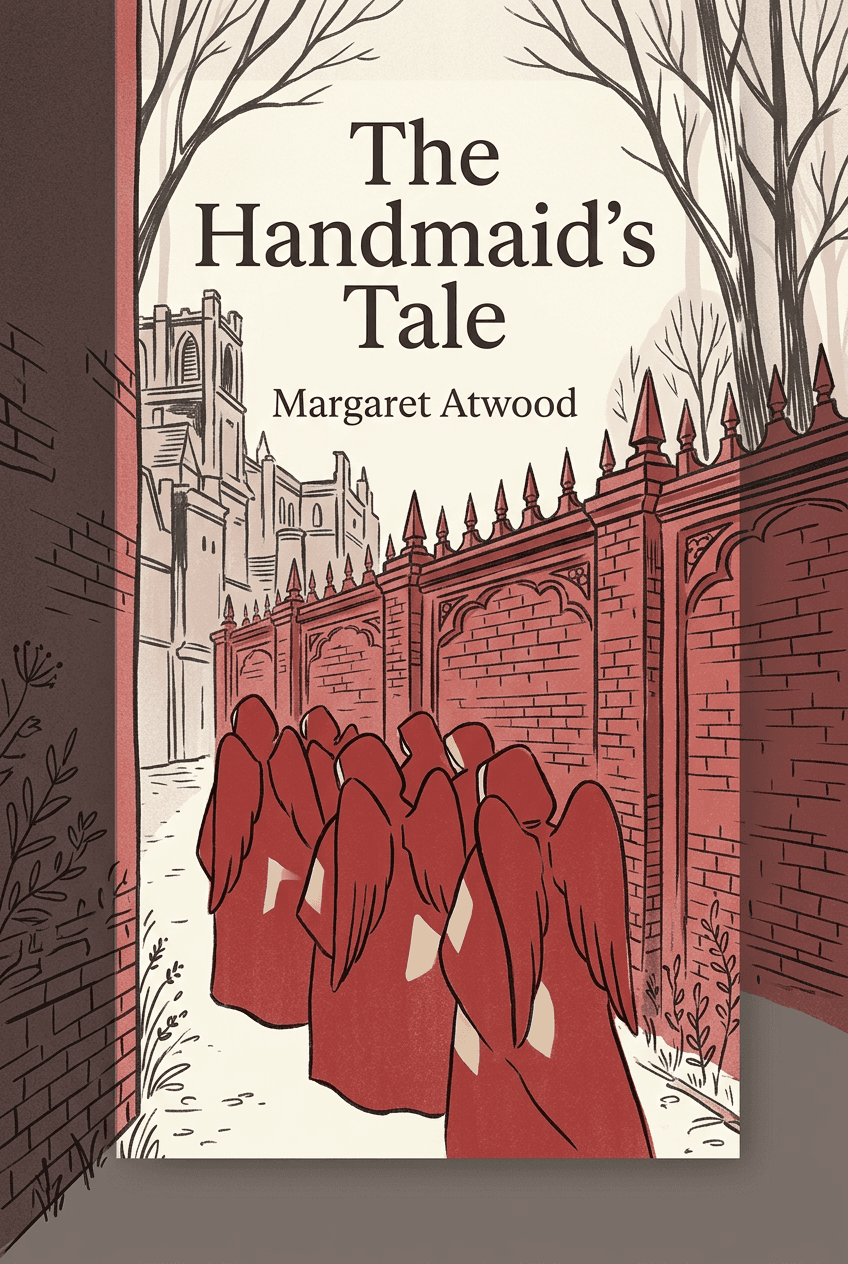
Margaret Atwood · 1985 · Dystopian fiction
The Handmaid's Tale
A chillingly plausible dystopia of a woman stripped of everything but her voice, in a near-future America remade as a religious dictatorship.
13 guided chapters · ~10 hours of reading
What it’s really about
On its surface, this is the story of Offred, a Handmaid in the Republic of Gilead, kept for her fertility and assigned to bear a child for a powerful man and his wife. Underneath, it is about power and the female body, about how a modern society can slide into totalitarianism, and about who is made to pay for that order. Atwood writes about subjugation, complicity, and survival with terrible clarity, and about memory and storytelling as the last territory a regime cannot fully seize. It is intimate, interior, and frightening precisely because so little of it is invented.
- Bodily autonomy & control
- Totalitarianism & complicity
- Religion & power
- Memory & storytelling
- Resistance & survival
From the Foreword
Before page one, a short orientation: the world, the writer, and how to read this particular book. Cross the threshold when you are ready.
- The world you're entering
- The author's moment
- Themes to carry
- How to read this one
Who it’s for
For readers drawn to dystopian and speculative fiction with real literary weight, anyone who values a fierce, interior narrator, and those who like a story that argues with them. If you appreciate George Orwell or Kazuo Ishiguro, or want fiction that illuminates the present by imagining a near future, this one is for you. Be ready for difficult material and an ending that refuses to tie itself up.